
On July 20, 2026, the European Commission activated the Digital Product Passport registry, introducing a testing environment for rehearsals. This followed the publication of the implementing regulation (EU) 2026/1778 three days prior. Yet, the launch went largely unnoticed by many apparel brands.
They should have paid attention. This passport signifies a data mandate entering an industry lacking in data capture. Apparel product information is often manually input rather than accurately measured. Measurements are read and dictated into spec sheets, fiber percentages are copied from supplier emails, and size charts prepared during development are rarely aligned with actual production.
The most cost-effective path to compliance is not through a formal project but through a measured garment record. This involves capturing data at the point when the garment is already handled. This includes dimensions, materials, care instructions, and identification, recorded per piece and timestamped as part of existing workflows.
What a digital product passport for textiles actually is
A digital product passport for textiles is a structured, machine-readable record linked to a garment through data carriers like QR codes or Data Matrix. It carries identification, material composition, circularity, and compliance information. This requirement stems from the EU's Ecodesign for Sustainable Products Regulation (Regulation (EU) 2024/1781), effective since July 18, 2024.
The architecture is more significant than brief summaries suggest. The EU registry only holds unique identifiers, not the passport itself. The data remains with the economic operator marketing the product within the EU or a third-party passport service provider. A backup copy through such a provider is mandatory as per Art. 10(4). The passport must be available for at least the product's expected lifespan (Art. 9(2)(i)) and survive the company's bankruptcy (Art. 11(e)).
This clause is telling. A regulation prepared for a company's potential bankruptcy indicates it's meant to be a record, not a marketing tool.
The responsibility aligns with market presence rather than the company's headquarters. The entity placing the product on the EU market uploads identifiers to the registry (Art. 13(4)), regardless of its registered location. Customs can only release imports into free circulation post-verification of the registration identifier against the registry (Art. 15). Dealers, including those engaged in distance selling, are required to provide the passport to customers (Art. 31).
The timeline everyone is reading wrong
The year 2027 is widely circulated, leading to misconceptions both ways.
The ESPR Working Plan 2025-2030, adopted on April 16, 2025, identifies textiles and apparel as a priority product group, with the textiles delegated act expected in 2027. The Commission's own indicative passport timeline projects textiles for Q3-Q4 2027. However, Art. 4(4) of ESPR specifies that a delegated act is applicable no earlier than 18 months post-enactment. This suggests that textile DPP obligations will realistically commence in 2028 or 2029. EURATEX proposed in a March 2026 position paper a transition period of 24 to 36 months, potentially delaying compliance further. Thus, 2027 is the year the regulations are established, not when compliance is required.
This provides more time than headlines imply, yet less time than it ostensibly appears, as the delay offers a chance to establish a data habit, a process that takes years.
Two developments are already underway. The EU battery passport becomes mandatory on February 18, 2027, approximately 18 months ahead of apparel, allowing providers, auditors, and carrier standards to undergo an initial live cycle. And one ESPR obligation already binds apparel. Since July 19, 2026, large companies are prohibited from destroying unsold clothing and footwear (Art. 25, Annex VII), with medium-sized companies following in 2030. The Commission cites EEA estimates that 4 to 9% of textiles placed on the EU market are destroyed before use, equating to between 264,000 and 594,000 tonnes annually.
What data will a textile passport ask for?
The definitive list remains unknown. A study by the Joint Research Centre published in May 2026 discusses proposed passport content for textile apparel but clearly states it is not binding on the Commission. The delegated act will ultimately determine the list.
Despite this, the study remains the best reference available. The proposed scope includes products with at least 80% textile fiber by weight. Content is divided into four categories: identification (GTIN, economic operator and facility identifiers, customs codes), product information (fiber composition, circularity data, substances of concern, a proposed durability score), environmental footprint, and compliance documentation. It also suggests a public tier accessible via scanning: identification, fiber composition, durability score, and care instructions.
Regarding identity, ESPR Annex III specifies the GTIN (ISO/IEC 15459-6). GS1's mapping determines the granularity. GTIN alone denotes the model level, GTIN plus batch indicates batch level, and GTIN plus serial signifies item level. The delegated act will decide which level is applicable to textiles, not the brands. CEN and CENELEC released the first six of eight European passport standards in late May 2026, addressing unique identifiers (EN 18219) and data carriers like QR codes and Data Matrix (EN 18220).
Reexamine the public tier. Three of its four elements are already printed on a sewn-in garment label.
Apparel's product data is typed, not measured
This is where the industry's approach becomes problematic.
In a tech pack, measurements are dictated, not captured. A sample is laid flat, a tape measure is used, a number is called out, and then manually entered into a system, which explains why the measurement section of a tech pack resembles transcription more than data. The inspection process shares this flaw. During intake or pre-shipment, the measuring step is the slowest and least reliable component. Two inspectors might generate two different chest measurements for the same garment. Nothing reconciles these differences.
Label data highlights the issue, as it is already structured but still manually retyped. Brand, size, fiber percentages, care symbols, country of origin, style codes, all printed, and then re-entered manually at the next step. Re-keying the label remains the apparel industry's most costly habit because it appears inexpensive at each workstation.
Overlay a passport obligation on this. Item-level identity, piece-by-piece traceability, and records that outlive the first sale and stay accessible after the brand's exit. A workflow relying on dictated spec sheets and one-time size charts cannot fulfill these requirements. It was never designed for this purpose.
The measured garment record and how it maps to passport fields
An alternative exists at a lower cost.
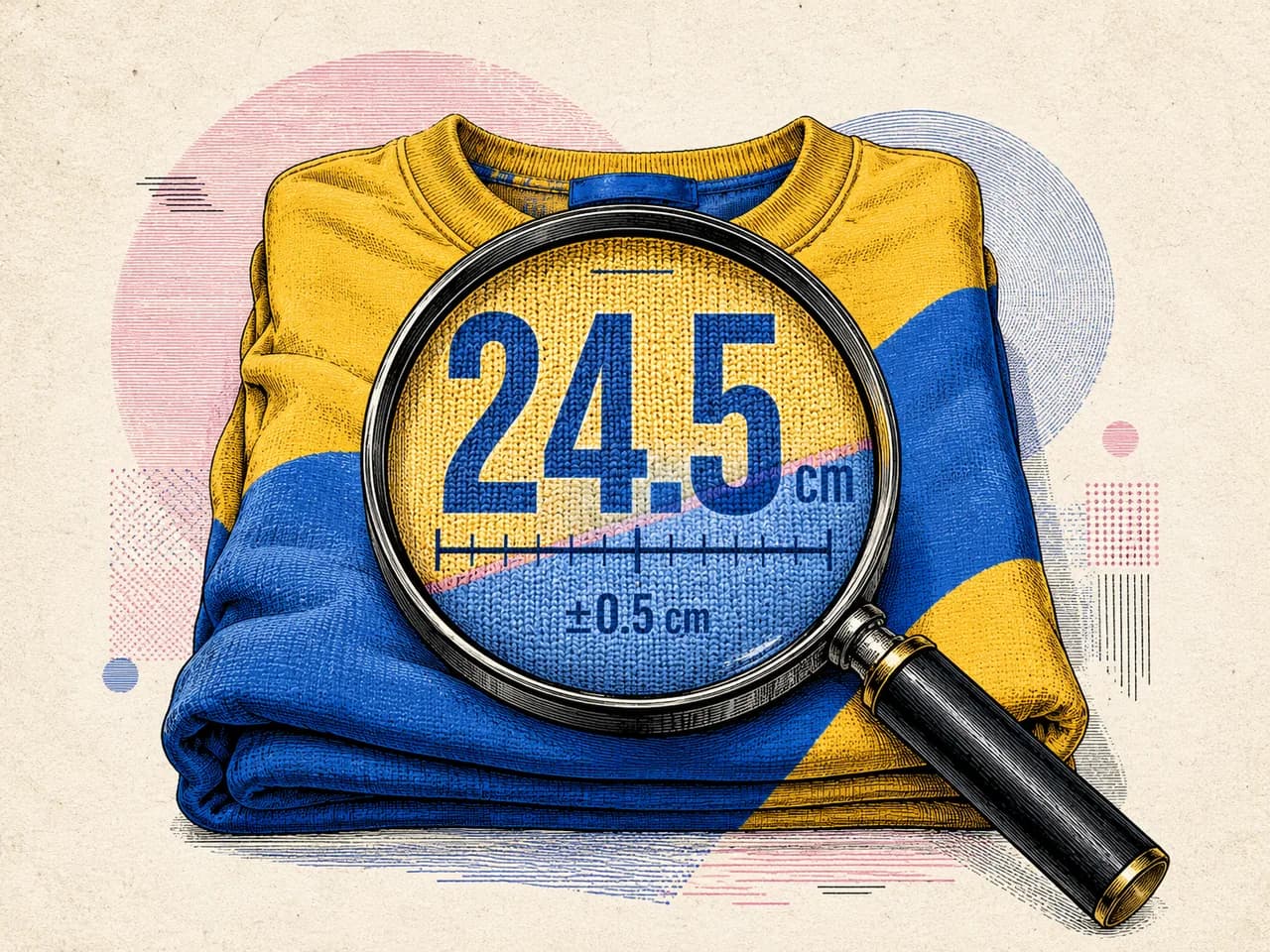
Rather than describing the garment, capture it. A flat-laid garment scanned with a LiDAR-equipped iPhone yields up to 15 measurement points, each with a confidence score, in 0.92 seconds, with an accuracy of approximately 5 mm (1⁄5 in). Non-LiDAR devices achieve about 9 mm (3⁄8 in) accuracy via the API. The Label Scanner simultaneously reads the care label, capturing brand, sizing, fiber percentages, care instructions, country of origin, style, and product codes. Barcode identifiers are attached to the same record. Size AI covers 90+ garment types.
This process generates a full per-piece record, including photos, points, measurements, label fields, and timestamps, which syncs once the device reconnects online.
| Proposed DPP data group | From one capture? | What the record carries |
|---|---|---|
| Identification | Partly | Style and product codes, barcode identifiers, brand, per-piece timestamp |
| Product information | Partly | Fiber composition percentages, care instructions, country of origin, up to 15 measurement points with confidence scores |
| Environmental footprint | No | Supply-chain and lifecycle data, not anything a garment holds |
| Compliance documentation | No | Test reports and declarations, held elsewhere |
The gaps in the data are important. Garment capture cannot deliver an environmental footprint or a test certificate. Any claim that a single scan completes a passport is misleading. Capture provides the identity and description layer currently typed in, which customs officers and recyclers rely on first.
The economics work because this is not an additional step. Capture occurs during inspection or listing, moments already integrated into the workflow. This argument is detailed on the QC page, which includes a section on passport readiness.
The same record that settles a dispute also feeds what's coming next.
A measurement that resolves a returns dispute now will serve as the basis for a passport field in 2029. Teams opting to integrate capture into their systems can access it through API and SDK infrastructure or contact us for a pilot with live workflow integration.
What does the passport mean for resale operations?
The reality is less expansive than marketing implies but remains valuable.
Second-hand products do not necessitate a new passport. ESPR categorizes them as not-new (recital 17), and GS1's provisional passport standard explicitly excludes second-hand goods. Thus, no passport is required for a jacket worn for three years.
However, four factors complicate this straightforward scenario. Passports must outlive the first sale due to the expected-lifetime rule extending beyond the point of purchase. Dealers must maintain passport accessibility for customers. A remanufactured product is considered new and requires its own passport linked to the original (Art. 11(1)(d)). The JRC study also notes a use case for second-hand resale data exchange, acknowledging that resellers often work with limited product data as care labels wear off or are removed.
Resale operations inherit the data rather than generating it, a favorable situation as long as the record persists. The public tier fields align with those needed for resale listings: composition, care, identity, measurements. Capturing this information during intake is not compliance work. It is listing preparation that coincides with compliance requirements.
Where to start before the delegated act lands
Do not begin with a passport vendor. The delegated act is unwritten, the field list unfixed. Acquiring a schema for non-existent rules is a recipe for redundant compliance expenditure.
The starting point is developing a capture habit, as it requires the longest lead time and offers benefits independent of EU directives. Consider these three questions in the current quarter: Which existing touchpoint involves handling every garment? How much of the recorded information relies on manual entry of already printed garment data? Could that location generate a per-piece record instead of a batch note?
Teams affirming the third question by 2027 will approach the digital product passport for apparel as a simple mapping task. Those unable to do so will face the challenge of creating a data pipeline while meeting compliance deadlines, an expensive and inefficient approach.
To explore what a measured per-piece record looks like with your product lineup, request access and we will coordinate a capture with you.