What this playbook is and what it argues
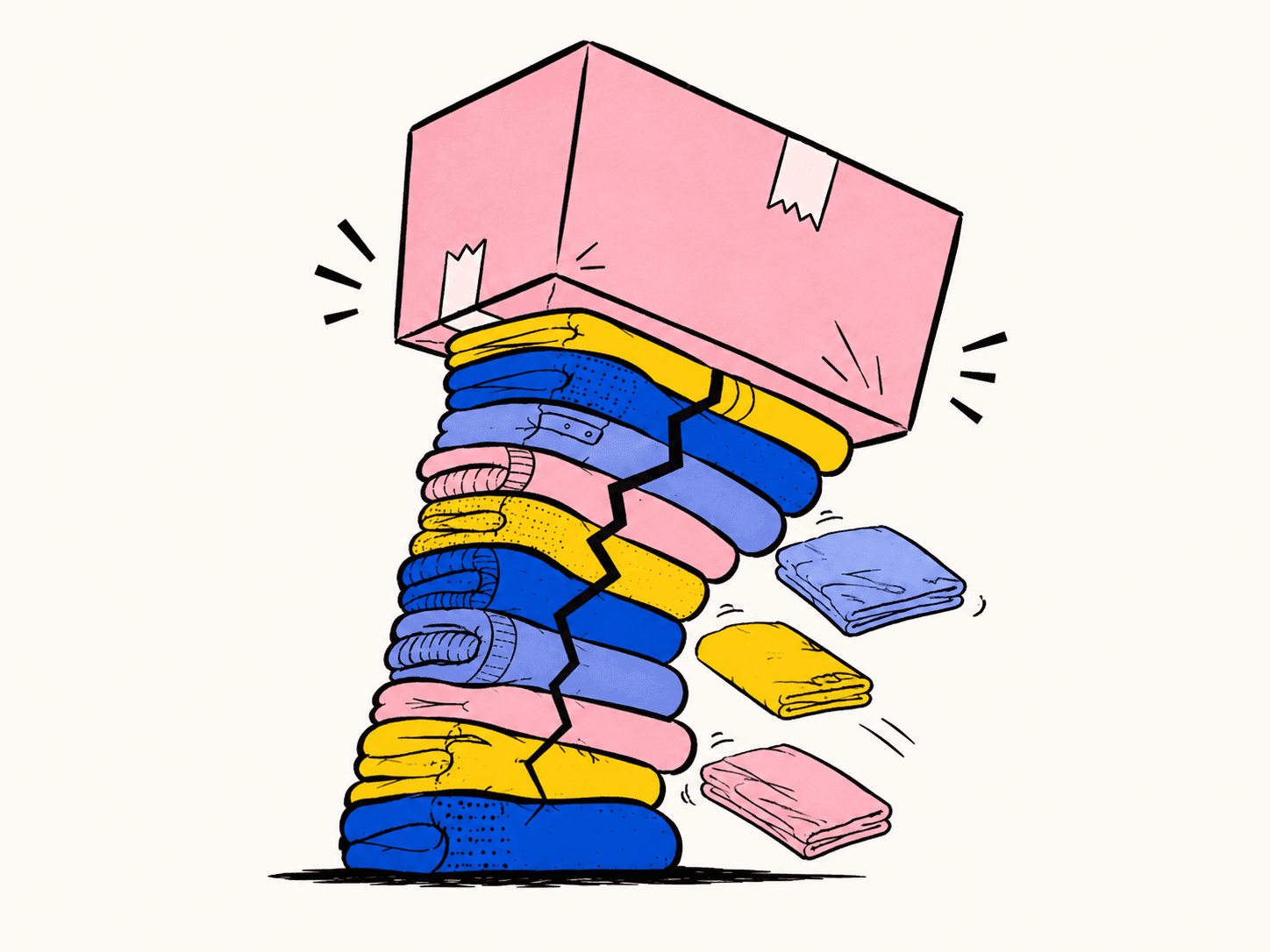
In 2024, US retail returns hit $890 billion, per NRF and Happy Returns. Apparel return rates run between 24% and 40% by category. A 2023 Coresight Research survey of 100 US apparel decision-makers found that 53% of those returns are driven by sizing issues. McKinsey puts the fit-related share closer to 70%.
Over the past decade, the playbook sold to brands promised a 30% to 40% reduction in fit-related returns. Most deployments delivered 2% to 8%. The underlying reason is structural, and it is not anywhere in the top 10 search results when a VP of Ecommerce types "fit-related returns" into Google. Size AI's take is grounded in over 1 million measurements captured by more than 10,000 fashion sellers.
This is the playbook.
What does a fit-related return actually cost a brand?
A single fit-related return costs between $43 and $70 when considering all economic factors.
| Cost element | Range |
|---|---|
| Outbound shipping | $8 to $12 |
| Processing and QA | $5 to $8 |
| Markdown risk | $5 to $15 |
| Lost customer LTV | $25 to $35 |
| Total per return | $43 to $70 |
Coresight estimates the US apparel sector spends around $38 billion annually on return processing alone. Optoro's industry data indicates an average processing cost of $46 per return. For a catalog with 50,000 SKUs operating at a 30% return rate, every percentage point reduction in fit-related returns is worth several million dollars annually, even before customer-LTV math compounds.
This is why the category has attracted significant vendor capital and why the gap between promised and actual reduction is significant.
Why first-generation fit-tech failed to budge the number
Three structural failure modes.
Cold-start blindness. Behavior-data inference vendors rely on existing return data (the recommend-an-M-or-an-L approach). The model lacks data on every new SKU until sufficient returns accumulate, an issue for seasonal collections and unique pieces. A brand with 200 SKUs in "Medium" has 200 different actual measurements, which the model often misses.
Survey friction. Survey-based vendors request body measurements at checkout, but most shoppers skip this step. Those who participate often misreport their weight enough to undermine recommendations, resulting in data that lacks the precision the algorithm requires.
Body-scan paradox. Body-scan vendors accurately capture the body but match it to a brand-supplied size chart that is rarely updated. While the body scan provides truthful data, the size chart is often outdated. Self-reported flat measurements vary by factory and season, rendering the size chart obsolete before shipping.
The common failure of past solutions was omitting the critical step of measuring the garment. Relying on behavior, body, or self-reports has its limits, and the industry has encountered them.
| Approach | Tech | Returns reduction |
|---|---|---|
| Traditional size chart | Static | 0 to 5% |
| M-or-L recommender | Behavior ML | 15 to 24% |
| Body-scan + brand size chart | 3D capture | 5 to 12% |
| Survey-based | Self-report | 3 to 7% |
| Per-SKU garment-data measurement | LiDAR + vision | 77% (24.4% to 5.5%) |
Per-SKU garment measurement cut fit-related return rates from 24.4% to 5.5%, a 77% reduction, for fashion sellers using Size AI.
The 5.5% figure reflects results from 10,000-plus fashion sellers when measurement is recorded at the listing stage rather than inferred from returns or surveys.
The discovery gap that nobody is naming
The entire returns-tech sector has overlooked a important aspect. Every fit-tech vendor addresses size recommendation: "You're an M, try this S." None focus on fit discovery: "You love how these jeans fit. Here are 47 other jeans that fit the same."
The former represents a size widget, while the latter introduces a structured catalog dimension previously unavailable.
An analysis of the top 10 search results for "fit-related returns" shows none address fit as a discovery issue. They all treat it as a recommendation challenge after the shopper has already filtered their inventory down to one item. Recommendations occur too late to influence the shopper's selection. By the M-or-L decision point, the shopper has bypassed 47 potentially better-fitting items in the catalog.
The full SERP audit is in our AI-in-fashion-2026 annual report. This gap is not minor. It is the largest unaddressed opportunity in the entire returns-reduction space.
Shop-by-fit as a discovery surface, not a recommender
Shifting fit considerations upstream into discovery is the intervention that compounds. Three reasons.
| Stage | Intervention | Typical reduction |
|---|---|---|
| Discovery (pre-PDP) | Shop-by-fit filtering | 25 to 40% |
| Decision (PDP) | Fit recommendation | 15 to 24% |
| Cart | Bracketing alerts | 5 to 12% |
| Post-purchase | Returns automation | 0% (cost shift, not prevention) |
Returns automation, provided by vendors like Loop, Narvar, AfterShip, Returnly, and Happy Returns, handles the logistics of returns post-purchase. While essential, they do not prevent returns.
Implementing shop-by-fit shifts the focus to when a shopper browses the catalog. They can point to a garment they admire, and the catalog reveals all dimensional matches across various categories, seasons, and silhouettes. The match is based on precise measurements (chest, waist, length, sleeve, inseam) instead of size labels or inferred behavior.
The delay in adopting this approach is due to the underlying data requirements. Shop-by-fit necessitates real per-SKU dimensional data throughout the entire catalog, measured garment by garment rather than inherited from a size chart. Most catalogs lack it.
The garment-data layer that makes shop-by-fit possible
Size AI processes over 200 structured data points per garment in just 0.92 seconds on an iPhone, achieving ~5 mm (1⁄5") typical accuracy with LiDAR in optimal conditions. This process reveals up to 12 measurements per garment (chest, waist, length, sleeve, inseam, and more). The label scanner adds 15-plus structured data points on top: brand, multi-format sizing, fiber percentages, a five-level stretch rating, and care codes.
The complete capture process runs on-device. Detailed methodologies are in our LiDAR engineering writeup and the canonical capture guide. The TrueShape rendering layer, responsible for producing clean, catalog-ready garment images, is outlined in the TrueShape guide.
These technical specifications build the data layer underneath shop-by-fit. Discovery filtering demands per-SKU dimensional accuracy at scale. The first iteration of fit-tech relied on static size charts. A brand may have 200 SKUs in "Medium," each with distinct actual measurements. Per-SKU data turns "fits like a medium" from a marketing phrase into a structured database column.
This data layer ships in production today through Size AI on iPhone and our AI Photo Studio on the ghost mannequin product page. Platforms and marketplaces can access the same per-SKU capture through Size AI's measurement infrastructure, delivered as an API and SDK. The consumer-facing iPhone workflow is in the ghost mannequin without a mannequin post.
David Nguyen, a CEO who piloted Size AI on 500 items, shared:
We tested Size AI on 500 items and saw immediate results: 45% faster listings, 35% fewer return requests, higher conversion rates. The model shots alone increased our average sale price by 18%.
A 35% reduction in return requests, an 18% increase in average sale price, and a 45% workflow improvement for items measured and listed through the pipeline.
Returns vendor stack vs garment-data layer
These components stack effectively. Here is a simplified operational view for a brand employing both:
| Layer | What it owns | Typical vendor |
|---|---|---|
| Discovery (pre-PDP) | Shop-by-fit filtering on per-SKU data | the gap, where Size AI fits |
| Decision (PDP) | Fit recommendation, size advice on the product page | First-gen fit-tech |
| Cart | Bracketing prevention | First-gen fit-tech |
| Post-purchase | Returns logistics, refunds, exchanges | Loop, Narvar, AfterShip, Returnly, Happy Returns |
Post-purchase returns vendors do not integrate per-SKU garment data natively, relying instead on existing catalog information. The discovery layer comes first, followed by the data layer.
For brands deciding where to invest in the latter half of 2026, the analysis points to discovery and its foundational data. Returns automation is necessary but not sufficient. A recommender based on an outdated size chart offers a 2% to 8% improvement. Rebuilding the data layer can yield a 30% to 77% impact.
The fit-related-returns playbook
Five steps. Each stands alone. Each improves the next.
- Audit per-SKU measurement coverage. Most catalogs start at 0%. The first SKU measured exposes the size-chart inaccuracies previously overlooked.
- Pilot garment-data capture on 50 to 500 SKUs. Prioritize categories with the highest returns, typically dresses and footwear. Establish a baseline the same way a tech pack's measurement spec does, then re-evaluate the same SKUs after 90 days.
- Incorporate fit as a structured field in your catalog. Treat fit as a real database column, not a marketing word. Display it in the product display page (PDP), search, and category-page filters.
- Deploy a shop-by-fit discovery surface. Filter the catalog by dimensional match. Shoppers select a reference garment, and the catalog shows dimensional matches.
- Monitor returns reduction by category, month over month. Category-level metrics shift first, with catalog-wide figures improving when coverage exceeds approximately 40% of revenue.
For brands interested in testing garment-data capture against their catalog this quarter, contact our team for a working session. The product ships today through Size AI on iPhone and the AI Photo Studio surface on the ghost mannequin page.